Ethan Rogers | Thomas Miller

Thomas Miller

Born in 1920, Thomas miller grew up in Bristol, Virginia then attended Virginia State College where he graduated in education with a focus on Art. He was not originally classically trained in art because the schooling just wasn't available to him at the time. Straight out of college he joined the military where he served until the late 40s when he was discharged. After being discharged he moved to Chicago and applied/got accepted to the Ray Vogue School of Art. He was the only black student at the institution and was one of 2 that were accepted into the society of typography. This was the big turning part of his career. At the Ray Vogue School of Art, he studied commercial and graphic art. 

Out of school Miller started looking for work and it was not coming easy, he got many offers from places, but they said he had to work from behind the scenes so people would not know they had a black designer. He decided that was unacceptable and declined every single one of the offers that had these "constraints" within them. Eventually, he got an offer from Morton Goldsholl Associates, which was a firm known for their progressive hiring. The firm owner's Millie and Morton Goldsholl studied at the New Bauhaus. He worked for Morton Goldsholls for 35 years and then moved on to making his own art (usually mosaics or monotypes). Many pieces of his art made it into museums.


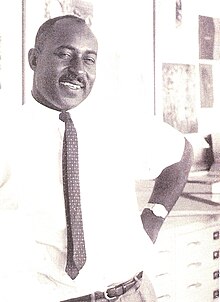
Thomas Miller.JPG

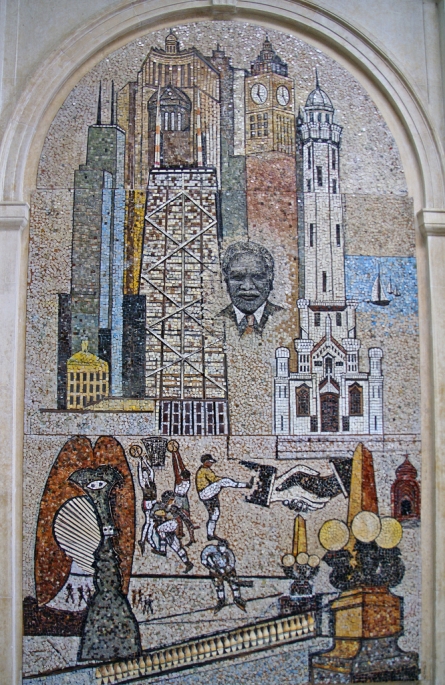
Chicago murals, mosaics: DuSable Museum features Thomas Miller ...


Miller did all sorts of marketing work at the Morton Goldsholl Associates firm like working on the logo and identity for Good Design. His most notable works were rebrands for large companies like 7up and Motorolla.

Motorola by Thomas Miller | 1955 #logotheke #logo #logomark ...

African-American Designers in Chicago' is an important corrective ...


Miller also had a successful run as a personal artist creating many pieces that made their way into art museums across the country.


10 Influential Black Designers from Past to Present

both of these pieces are featured in the DuSable Museum of African American History in Chicago.


Miller was one of the pioneering black designers and he was the only black student at the prestigious Ray-Vogue school of Design. He proved that he belonged in the design world with countless awards in design as well as being one of the two black designers to be accepted into the Society of Typographic Art at the time. From 1950 to 1985 he had a very successful career at a very successful firm and he was highly recognized the whole time. After his retirement from the design firm, he took the world of art by storm creating numerous works of art that are still featured in museums.


Supporting Links


Comments

Popular posts from this blog

Beverly Loraine Greene (1915-1957)

Beverly Loraine Greene was born October 4 th , 1915 in Chicago Illinois. Although she was born during a time where she was not accepted in the professional world she never stopped moving towards her goal of becoming an architect. In 1936, Greene made history by becoming the first African American female to earn a bachelor of science degree in architectural engineering from the University of Illinois at Urbana Champaign. Although she was “ amidst a sea of white male faces” at school, Beverly was known for having a calm presence that allowed her to focus on her difficult education (Illinois.edu). After graduating she began to search for a job in the industry, albeit the many obstacles in her way. Although it was difficult to find work at first due to racial discrimination, Greene’s talent and drive landed her a job with the Chicago Housing authority. This made her the first African American to be a part of the Chicago Housing authority, a corporation that oversees the housing in the cit...

Let's fix history

OK, you're down to do the work. Cool. First, let's talk about what we mean by "Design" and "Designer". Design as a formal profession has only been around for a relatively short time, during which BIPOC were systematically excluded from both higher education (where designers become formalized) and industry (where designers work). On top of this, systematic oppression of BIPOC has kept their wealth and power in the economy low, which is used as a justification not to design with or for these end users. So, we will need to expand our idea of design beyond that which is done by formally trained designers. Instead, we should think about all traditions of problem solving which try to satisfy human need with technological capability, while pursuing an aesthetically beautiful solution. These may include traditional crafts, toolmaking, architectural design or decoration of traditional buildings, traditional graphical motifs and styles, letterforms or scripts, graphic...

Althea McNish, Trinidadian Textile Designer

By Katrina Filer Born in Trinidad but living in the foggy, grey world of London in the 50s, Althea McNish brought the colorful inspiration of her birthplace to the British textile scene. She was descended from former Black slaves who had fought for the British in the war of 1812, and she was born while Trinidad was still a colony, 38 years before they gained independence. Her impressionist-style prints based in the Caribbean's natural beauty were groundbreaking, pushing the way that her contemporaries looked at fashion, interior design, or anything else that could hold a pattern. Surrounded by a culture that constantly appropriated the art of its colonies (Trinidad included) and deep in a white male-dominated field, McNish still found her place in the fashion and textile industry, wielding genre-defining abstractions of tropical and floral beauty.  Angela Cobbinah. Althea McNish in 2008. Photography courtesy of the Camden New Journal. McNish's early life in Trinidad was charact...